
The global market landscape is undergoing a technology-driven transformation, granting resource-limited SMEs the opportunity to compete on equal footing with industry giants for the first time. As live-streaming e-commerce transcends geographical barriers to become a new global consumption norm, and as smart tools significantly lower the threshold for professional operations, lightweight global expansion strategies have become feasible. This article systematically deconstructs replicable practical strategies, focusing on the synergy between intelligent tools and global deployment.
The globalization of live-streaming e-commerce has spawned breakthrough opportunities in vertical categories. Tool-based products leverage China's supply chain advantages to establish price competitiveness, while collectibles rely on cultural resonance to create differentiated barriers. Notably, platform traffic support policies provide a critical window for cold starts, requiring content design to balance entertainment and utility while avoiding hard-selling tactics that harm user experience. The proliferation of smart tools is reshaping operational logic: multilingual content generation addresses core localization pain points, intelligent ad systems optimize conversion paths, and automated customer service reduces response times. For example, LnRu’s industry-specific models use deep learning to achieve precise cultural context adaptation, significantly reducing translation errors that trigger cultural conflicts. Emerging markets exhibit synergistic growth, with Southeast Asia, the Middle East, and Latin America forming a strategic triangle. A dual-track strategy is recommended—deepening core markets while testing potential ones. For instance, 3C products can first validate market response in the Philippines, while near-shore setups optimize tariff costs and logistics efficiency.
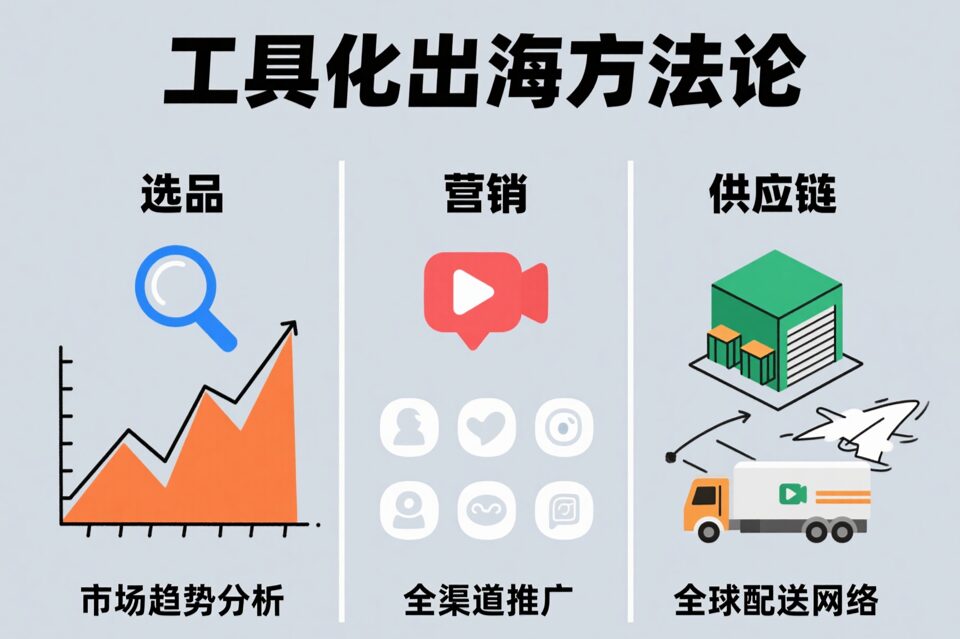
Product selection requires a three-tier data filtering mechanism. First, analyze search trends in target markets to identify unmet demand gaps. Second, validate market feedback through small-batch trial production to control testing costs. The marketing system should integrate dual engines—content and traffic—with short videos employing scenario-based storytelling for immersion, podcasts establishing professional credibility, and community engagement nurturing high-value user groups. Dynamically balance organic and paid traffic to avoid over-reliance on single channels. Supply chain development prioritizes flexibility: transit hub models mitigate tariff risks, while micro-overseas warehouse networks enhance fulfillment efficiency. Logistics combinations must align with product traits and delivery requirements.
Risk control requires preemptive cultural adaptation to avoid cognitive biases from direct translation. Smart review tools are advised to flag sensitive phrasing, supplemented by localized content moderation workflows. Payment systems must integrate mainstream local methods to prevent conversion drop-offs. Inventory management adopts a tiered model, combining pre-sales mechanisms with safety stock to curb overstock risks. By 2026, capability building should focus on three dimensions: systematizing user behavior data to train customized AI models, expanding language matrices (e.g., Spanish, Arabic) for emerging markets, and stress-testing supply chains for extreme scenarios. As smart tools automate 80% of baseline operations and live-streaming dismantles traditional channel barriers, success shifts from capital scale to tech application prowess. Platforms like LnRu construct global gateways via multilingual business cards, integrating real-time inquiry systems and global CDN acceleration to help SMEs complete the full cycle—from cultural adaptation to deal conversion—without dedicated teams.