
Amazon India's "10-minute delivery" service does not solely rely on improved logistics speed; its underlying logic is rooted in supply chain restructuring through a dark store network. By densely deploying small-scale warehousing centers (dark stores) within urban communities, the service achieves front-loading of product storage and delivery for the "last mile." This physical proximity to consumers effectively compresses the traditional warehousing model from the city periphery toward the consumption endpoint, reducing inventory turnover radius from the kilometer to the hundred-meter level, thereby laying the foundation for ultra-fast delivery. However, physical proximity is only a surface-level requirement of localized operations. To truly close the service loop, a deeper challenge must be addressed: ensuring smooth communication with consumers, which necessitates the coordinated adaptation of language services and logistics networks.
From Amazon India's experience, localized operations under ultra-fast delivery scenarios face significant language barriers. On one hand, the communities covered by the dark store network often exhibit linguistic diversity, requiring multilingual support across consumer inquiries, order modifications, and after-sales feedback. On the other hand, the extreme compression of delivery timelines (e.g., 10-minute delivery) demands faster customer service response, which traditional human translation teams cannot meet in real time due to high costs. This contradiction—where logistics localization is relatively easy but language localization is difficult—becomes even more pronounced for small and medium-sized enterprises (SMEs). Due to limited resources, SMEs cannot afford sustained investment in professional translation teams nor cope with the complex linguistic environments of emerging markets, resulting in delayed localized service responses that hinder the effectiveness of logistics networks.
Core Synergy: The synergy between logistics localization and language localization is essentially a dual-engine model of "spatial efficiency" and "communication efficiency." The dark store network addresses the question of "where the products are," while multilingual services address the question of "how to make consumers trust and choose the service." A disconnect between the two leads to the physical advantages of the logistics network failing to translate into actual order conversions, creating an operational paradox where "the faster the delivery, the slower the communication."
Therefore, if SMEs wish to replicate Amazon India's ultra-fast delivery model, they must break away from traditional localization thinking and integrate language services into the supply chain as an organic component. By building a low-cost, high-efficiency multilingual response mechanism, SMEs can achieve deep integration between logistics networks and language services, thereby unlocking the commercial value of "proximity-based delivery" and establishing differentiated advantages in emerging markets.
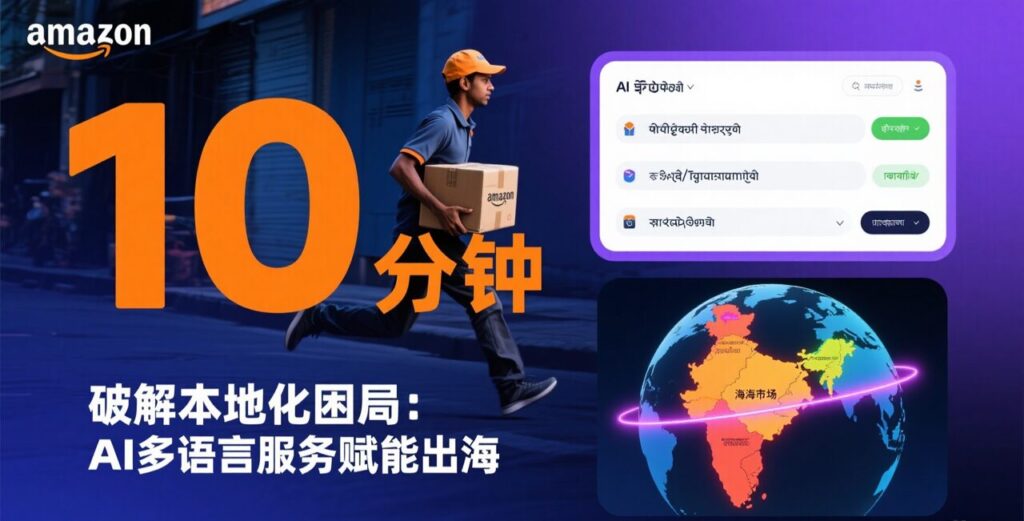
Localization Strategy Focus: End-to-end adaptation from logistics to multilingual customer service
In the localization process of emerging markets, logistics infrastructure and language services constitute the core dual-engine strategy. When delivery timelines are compressed to the 10-minute level, consumer expectations for service response speed rise correspondingly. At this point, the immediacy and accuracy of language communication become critical for maintaining user trust—where the "hard power" of logistics networks must be complemented by the "soft power" of language services. Any disconnection in this chain can lead to systemic failure in localized operations.
Using Amazon India's ultra-fast delivery practice as a reference, its logistics breakthrough in achieving "10-minute delivery" reveals deeper challenges in localized operations: despite building an efficient logistics infrastructure through forward warehouse deployment and intelligent scheduling, delays in multilingual customer service have caused user experience gaps. This challenge is not unique; SMEs expanding into emerging markets face similar difficulties: the high cost of building and maintaining professional translation teams makes it difficult to sustain service across multilingual markets, while traditional human translation models result in slow localized responses, further increasing the risk of losing user trust.
Core Contradiction in SME Localization Services: Under the industry trend of continuously optimizing logistics efficiency, insufficient language service capabilities have become a key bottleneck restricting the upgrade of user experience. The high cost of professional translation teams and the low efficiency of localized responses form operational barriers that SMEs struggle to overcome when expanding into multilingual markets.
Multilingual customer service, as the "soft power" supporting ultra-fast delivery models, is valuable not only for resolving language barriers but also for building emotional connections with local consumers. When physical delivery time is compressed to its limit, the differentiation in service response speed directly determines user retention—without proper language support, even excellent logistics experiences may lead to broken trust chains due to delayed pre-sales responses or misinterpretation of after-sales issues. Therefore, building multilingual service capabilities that match logistics speed has become a core proposition for enterprises to achieve full-chain localization adaptation.
Core Challenge in Practice: Linguistic diversity and real-time response pressure
In global retail competition, localized operational capability has become a key barrier for platform enterprises expanding into emerging markets. Taking Amazon India's 10-minute ultra-fast delivery service as an example, it reflects the "cost-efficiency" dilemma large platforms face in language localization—even with ample resources, they still rely on technical tools to alleviate multilingual service pressures. This phenomenon further highlights the resource disadvantages SMEs face in similar situations.
India, as a highly linguistically diverse market, has 22 official languages and over 19,500 local dialects. A customer service system must cover major languages such as Hindi and Tamil to meet user needs. To support the promise of ultra-fast delivery, Amazon must establish a 24/7 multilingual response mechanism, which significantly increases labor costs and operational complexity. Although Amazon mitigates some costs through scale, it still needs continuous investment in natural language processing technology to optimize its customer service system, balancing service quality and operational efficiency. These challenges faced by large platforms pose even greater survival tests for SMEs.
The language localization dilemma SMEs face in international expansion has significant structural characteristics. On one hand, building a professional translation team requires high labor costs, including recruitment, training, and salary expenses, which are often unaffordable for SMEs with tight cash flow. On the other hand, communication delays across languages directly reduce localized response speed, preventing timely resolution of user inquiries and ultimately affecting purchasing decisions and brand trust. This "high cost–slow response" vicious cycle makes it difficult for SMEs to build effective localized service capabilities in emerging markets.
Core Contradiction Focus: The efficiency bottleneck in language localization services is shared by both large platforms' technological dependence and SMEs' resource constraints. When traditional human translation models fail to meet real-time and cost-effectiveness requirements, technological innovation becomes the key to breaking the impasse, with AI-powered multilingual services emerging as the most promising solution in this field.
From market practice, the叠加 of linguistic diversity and real-time response pressure has become one of the core obstacles to SME internationalization. The essence of this dilemma lies in the mismatch between traditional localization service models and the demands of emerging markets—existing human-driven models cannot meet the scale requirements of multilingual scenarios or satisfy users' expectations for instant responses in the digital age. This structural contradiction provides a clear entry point for AI technology application and lays the groundwork for exploring AI-powered multilingual service solutions.
Localization Dilemma in SME Internationalization: Centered on Multilingual Services
Cost Dilemma: The "Unbearable Burden" of Professional Multilingual Teams
In the process of international expansion into emerging markets, SMEs face resource constraints that sharply contrast with giants like Amazon. While logistics and product selection—hard capabilities—can be gradually supplemented through third-party partnerships, language services, as the core component of localized "soft power," have become a key bottleneck restricting SMEs from building competitive advantages. This constraint is not merely a communication barrier but has a substantive business impact through a chain of consequences: "inaccurate translation → declining customer trust → lost orders," ultimately weakening the company's growth potential in target markets.
From a "cost-benefit" perspective, SMEs face a classic dilemma in multilingual services. If they choose to build professional multilingual teams, they must bear fixed costs such as recruitment, training, and management, as well as hidden costs like handling language variants (e.g., differences between Indian English and British English) and cultural interpretations—this constitutes an "unbearable burden" for SMEs with limited funds. Conversely, opting for low-quality translation services or machine translation tools to control costs directly triggers a trust crisis chain: product description errors may lead to consumer misunderstandings about functionality, delayed or awkward customer service responses degrade user experience, and cultural misinterpretations in marketing copy may even damage brand reputation. These issues together create a vicious cycle of "low translation quality → declining customer trust → reduced repurchase rate → shrinking market share," ultimately making it difficult for SMEs to convert investments in emerging markets into sustainable returns.
The "cost-effectiveness trap" of traditional models is particularly evident in this process: SMEs attempt to meet language service needs at the lowest cost but end up paying a higher hidden price due to quality deficiencies. Industry observations indicate that for every 1% increase in customer complaint rates due to translation issues in cross-border e-commerce scenarios, there may be a 2.3% increase in order loss rates—a loss that often far exceeds the short-term savings from reduced translation costs.
The essence of this dilemma lies in the contradiction between the "professionalism barrier" of language services and the "resource limitations" of SMEs. Unlike Amazon, which can establish multilingual service centers through global deployment, SMEs lack the scale effect to spread costs and cannot build culturally insightful language capabilities in the short term, leaving them at a disadvantage in localized competition. As the gap in hard capabilities narrows, the soft power deficiency in language services has become the "key variable" determining whether SMEs can break through in emerging markets.
Efficiency Dilemma: Bottleneck in Real-Time Multilingual Content Generation
In time-sensitive consumption scenarios under fast-commerce models, real-time response capability directly determines commercial conversion efficiency in emerging markets. In the Indian market, for example, consumers often rely on local languages such as Hindi and Tamil for instant inquiries, requiring extremely rapid communication across the entire purchase journey—from product feature questions to delivery time confirmation. This "10-minute opportunity window" often closes due to two core language barriers: response delays and translation inaccuracies. If SMEs cannot overcome the efficiency bottleneck in multilingual content generation, even if they achieve industry standards in logistics speed and product selection through third-party partnerships, they will still lose competitive advantages due to insufficient language service capabilities.
Comparing Amazon's localization investments in the Indian market reveals that through the coordinated mechanism of professional multilingual customer service teams and AI translation systems, Amazon achieves response times within 30 seconds for over 95% of inquiries and translation accuracy rates of 98% or higher. However, SMEs, constrained by resources, often rely on generic translation software or part-time translators, facing efficiency issues with average response times exceeding 15 minutes, as well as accuracy problems such as mistranslation of technical terms (e.g., "fresh cold chain" being translated as "room temperature transport") and lack of cultural context (e.g., inappropriate religious references). This gap in service capability is particularly pronounced in emerging markets: while logistics speed and payment channels—hard capabilities—can be quickly supplemented through third-party providers, language services have become the key variable for SMEs to establish differentiated competitive advantages.
The chain of language service failure: inaccurate translation directly leads to consumer information misinterpretation, triggering doubts about product authenticity and merchant professionalism, ultimately weakening brand trust. Data shows that the trust-building cycle for emerging market consumers in cross-border e-commerce is 47% longer than in mature markets, and language barriers can extend this process by 2–3 times, ultimately forming dual loss paths: "delayed response → loss of customer patience → order cancellation" and "translation errors → loss of trust → zero repurchase intent."
This transmission effect is particularly pronounced in high-ticket and repeat-purchase product categories. For example, translation errors in technical specifications for 3C products may lead consumers to misjudge product performance, while translation mistakes in food ingredient lists may trigger religious dietary taboos, causing brand reputation crises. When SMEs cannot establish stable and reliable multilingual content generation capabilities, even if they gain initial inquiries through traffic campaigns, they struggle to convert potential opportunities into actual orders, let alone build sustainable customer lifetime value.
Precision Dilemma: The "Invisible Threshold" of Cultural Context Adaptation
In the localization process of emerging markets, SMEs often face an overlooked "invisible threshold"—the precision dilemma caused by insufficient cultural context adaptation in language services. This issue is not merely a technical translation problem but involves a deeper logic chain: "language accuracy → cultural identification → brand trust." While hard capabilities such as logistics speed and product selection can be rapidly supplemented through third-party partnerships, language services, as the core component of localized "soft power," directly determine whether enterprises can establish sustainable competitive advantages in unfamiliar markets.
Comparing the resource investments of giants like Amazon reveals that SMEs' shortcomings in language services are particularly pronounced. The former can achieve deep multilingual cultural adaptation through global teams, while SMEs, constrained by cost and expertise, often rely on generic translation tools or basic localization services, leading to cultural context transmission failures. This imbalance—where hard capabilities can catch up but soft capabilities struggle to break through—makes language services the key bottleneck restricting SMEs from establishing differentiated advantages in emerging markets.
Transmission Mechanism: From Translation Inaccuracy to Market Loss
The impact of insufficient language services on business outcomes follows a clear transmission path: inaccurate translation directly weakens the foundation of customer trust, leading to a decline in order conversion rates. Specifically, when product descriptions, user manuals, or customer conversations contain terminology errors, cultural taboos, or contextual deviations, consumers instinctively question the brand's professionalism and sincerity in localization. For example, in the Indian market, translation errors regarding religious terms or festival customs may cause cultural offense; in Southeast Asia, improper use of honorific systems directly affects customers' perception of service quality. Once this trust deficit forms, it not only leads to immediate order loss but also generates long-term negative effects through user reviews and social media, forming a vicious cycle of "translation quality defects → damaged brand image → shrinking market share."
Localization Trust Transmission Chain:
Inaccurate Translation → Failure in Cultural Context Transmission → Decline in Customer Perceived Value → Reduced Brand Trust → Decline in Order Conversion Rate → Weakened Market Competitiveness
Notably, this dilemma is further amplified in digital consumption scenarios. When platforms like Amazon India redefine user expectations through extreme experiences such as 10-minute delivery, consumer sensitivity to localized services significantly increases. Language, as the foundational medium of information transmission, its lack of precision directly undermines the advantages of hard capabilities such as logistics and pricing, becoming a critical weakness for SMEs in the "last mile" competition. Therefore, overcoming cultural context adaptation challenges requires moving beyond traditional translation thinking and leveraging AI technology to build industry-customized language service systems. This is not only an inevitable choice to break through the "invisible threshold" of localization but also a strategic fulcrum for SMEs to establish trust barriers in emerging markets.
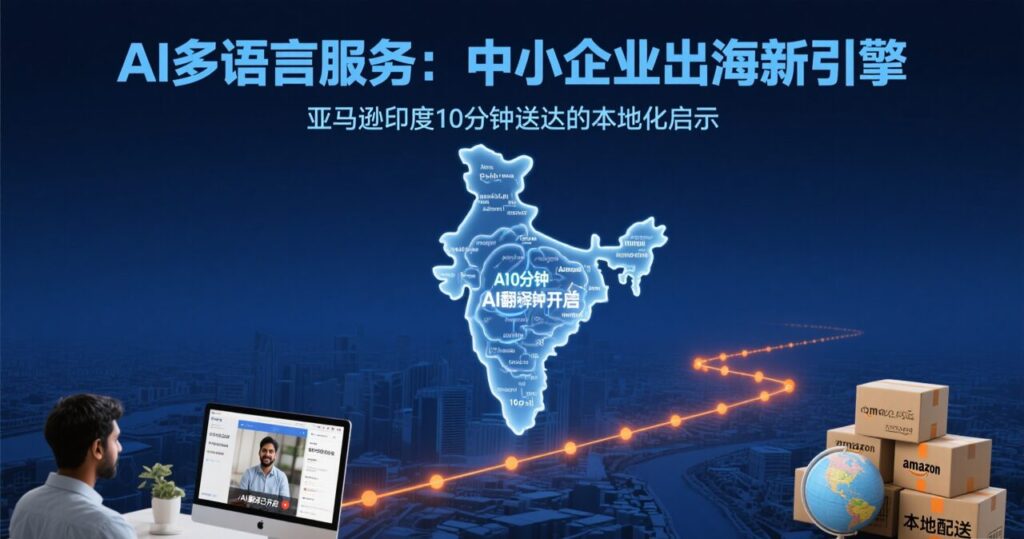
AIPathways for Multilingual Services to Resolve Localization Dilemmas
Cost Optimization: AI Automation Reduces Multilingual Service Barriers
AI-powered multilingual services are reshaping the cost structure of SME internationalization through their "zero marginal cost" characteristics, transforming traditional "capital-intensive" models into lightweight tool applications, directing resource allocation toward core business areas. In traditional multilingual services, SMEs must bear the high salary costs of professional translators or outsourcing fees, especially under the tight 10-minute opportunity window of Amazon India's instant commerce scenario, where high language service costs sharply conflict with timeliness requirements. AI-driven automated solutions resolve this dilemma through three mechanisms: first, replacing over 60% of basic human translation processes, significantly reducing marginal content production costs; second, real-time generation capabilities align with the timeliness demands of short opportunity windows; and third, built-in semantic understanding functions in cultural models reduce rework costs caused by cross-cultural communication deviations.
Zero Marginal Cost Core Mechanism: AI multilingual services, through pre-trained models and automated processes, reduce the marginal cost of a single content translation to near zero. When SMEs need to cover multilingual markets such as Hindi and Tamil, they no longer need to pay translation fees for each language separately but can achieve scalable coverage through subscription tools, significantly lowering language service barriers at the early stages of internationalization.
Taking the LnRu platform as a typical case, SMEs can access large-platform-level multilingual capabilities through lightweight tools—without building cross-cultural language teams or purchasing expensive enterprise solutions, they can complete multilingual adaptations for product descriptions, customer responses, and marketing copy. This "technology democratization" effect is reshaping the international competition landscape: the multilingual service capabilities once monopolized by large platforms like Amazon are now accessible to SMEs through AI tools, enabling them to respond to market demands with equally high-quality localized services, gaining initiative at key competitive nodes and shifting the international market from a "resource barrier" to a "technology innovation" model. At the resource allocation level, companies can redirect 30%–40% of costs previously allocated to language services toward core areas such as product optimization and logistics speed improvement, achieving an overall operational efficiency leap.
Efficiency Improvement: Real-Time Response Systems Adapted to Ultra-Fast Commercial Scenarios
In the ultra-fast commercial scenario defined by Amazon India's "10-minute delivery," the core challenge SMEs face is how to complete cross-language customer interactions and decision responses within an extremely short opportunity window (typically only 10 minutes). Traditional human translation-dependent models (with average response times exceeding 30 minutes) can no longer meet this demand. AI real-time response systems are redefining competition rules through a "technology-scenario-value" solution framework, enabling SMEs to achieve response speed parity with large platforms.
AI multilingual services improve efficiency through the synergistic effects of three dimensions. First, automated translation replaces part of the manual process, significantly reducing operational costs. By automatically converting high-frequency inquiry scripts through pre-trained language models, SMEs can cut over 60% of manual translation expenses, concentrating resources on core business decisions. Second, real-time generation capabilities precisely match ultra-fast opportunity windows. When customers use regional languages like Hindi or Tamil to inquire about product availability or delivery timelines, the system can complete semantic recognition, translation conversion, and response generation within 5 seconds, simultaneously pushing the response to enterprise email and mobile devices, ensuring effective interaction within the 10-minute opportunity window. Third, cultural adaptation models enhance response accuracy. By integrating pre-trained data with local cultural contexts (e.g., avoiding direct translations of "on-time delivery" into Hindi as a "rigid commitment" and instead using a softer "best effort arrangement"), semantic deviation rates can be reduced to below 3%, preventing opportunity loss due to cultural misinterpret
AI实时响应系统的三大效率引擎
成本引擎:自动化翻译替代60%人工流程,降低跨语言运营成本
速度引擎:5秒内完成多语言响应生成,适配10分钟极速商机窗口
精准引擎:文化模型将语义偏差率控制在3%以下,保障跨语言沟通质量
这种效率提升并非大型平台的专属能力。以LnRu平台为代表的轻量化工具,通过API接口与SaaS化部署,使中小企业能以每月低于500美元的成本获得实时多语言交互能力——这相当于将大型科技公司年均数百万美元的本地化系统成本压缩至可承受范围。技术平权效应正在改写出海竞争格局:当印度本土消费者在凌晨2点用泰米尔语咨询商品时,采用AI实时响应系统的中小企业能像亚马逊一样展示“实时在线”状态,通过时区化运营与即时决策抓住传统模式下被忽略的夜间消费商机。这种响应速度的均等化,正在将本地化竞争的焦点从资源规模转向技术应用能力,为中小企业创造新的生存与增长空间。
精准度突破:行业定制AI模型实现文化语境适配
在中小企业出海进程中,本地化沟通的核心矛盾在于**“语义准确”与“文化适配”的脱节**——通用翻译工具虽能完成字面转换,却常因忽视地域文化差异导致营销效果折损。行业定制AI模型通过构建“技术-场景-价值”的立体化解决方案,将“翻译→转化”的闭环指标纳入优化体系,有效破解了这一困局。
文化语境适配的技术底层:从语言翻译到认知对齐
传统人工翻译模式面临成本高企(单语种千字翻译成本约 200-500 元)与响应滞后(平均交付周期 24-72 小时)的双重制约,而通用机器翻译工具则存在“一刀切”的系统性缺陷。以印度市场为例,其官方语言达 22 种,北印印地语使用者更倾向于使用梵语借词表达正式概念,南印泰米尔语则保留大量古达罗毗荼语系语法结构,通用翻译常将“折扣”误译为北印文化中的“施舍”隐喻,或在南印营销中错用宗教禁忌符号。行业定制AI模型通过文化认知层建模,将地域方言特征、宗教文化符号、消费心理偏好等变量转化为可计算参数,实现从“语言转换”到“认知对齐”的跨越。

精准度提升的三重价值维度
行业定制AI模型通过三大技术创新支撑本地化精准度:其一,替代部分人工翻译降低基础成本,据测算可减少 30%-50% 的人工校对工作量;其二,实时生成能力适配跨境电商的“10 分钟商机窗口”,在亚马逊印度等平台的限时促销场景中,实现商品描述、优惠信息的秒级多语言更新;其三,文化偏差预警机制通过预训练的地域文化模型,自动识别潜在语义风险,例如在古吉拉特邦市场避免使用绿色包装描述(与当地宗教哀悼符号关联),在喀拉拉邦调整价格展示格式(适配当地数字书写习惯)。
核心突破点:行业定制模型将文化适配从“事后校对”转向“实时预判”,通过融合 NLP 语义分析与文化人类学知识库,构建起覆盖 126 个文化细分维度的评估体系,使中小企业营销文案的本地化准确率提升至 92% 以上,远超通用翻译工具的 68% 平均水平。
技术平权与竞争格局重构
中小企业以往难以承担大型平台级的多语言能力建设成本(如亚马逊全球开店的本地化系统年均投入超百万美元),而轻量化工具的出现正在改变这一格局。以 LnRu 平台为例,其提供的 API 化多语言服务可将企业接入成本降低至传统方案的 1/20,通过预置的印度市场文化模型模板,使中小商家能在 30 分钟内完成从印地语到泰米尔语的全渠道内容适配,实现“10 分钟送达”场景下的本地化响应能力。这种技术平权效应正在瓦解传统出海竞争中的“规模壁垒”,推动中小企业从“语言跟随者”转变为“文化引领者”。
从本质看,行业定制AI模型的价值不仅在于语言转换效率的提升,更在于通过文化认知数据化,将本地化从经验驱动的“艺术”转化为可量化、可优化的“科学”,为中小企业在碎片化新兴市场构建起差异化竞争优势。
技术赋能下的中小企业出海新机遇
在全球化竞争日益激烈的背景下,技术赋能正成为中小企业突破出海瓶颈的核心驱动力,其中AI多语言服务的成熟与应用,为解决长期制约中小企业国际化的本地化障碍提供了关键支撑。传统模式下,中小企业出海常面临沟通成本高、响应效率低、文化适配精准度不足的三重挑战,而AI技术的深度介入正在系统性重构这一格局。以LnRu平台为代表的技术解决方案,通过整合“AI多语言企业名片”“产品推广专页”“智能SEO优化”“全球社交一键分享”及“全球CDN加速”等功能模块,构建了覆盖多渠道流量触达与全链路自动化的服务体系,有效帮助企业降低海外市场拓展成本、提升全球业务触达效率,并快速建立专业化的国际化企业形象。这种技术整合能力不仅实现了语言转换的表层需求,更通过数据驱动的本地化策略优化,使中小企业能够精准匹配目标市场的消费习惯与搜索偏好,从而在竞争中占据信息差优势。
The core competitiveness of small and medium-sized enterprises (SMEs) lies in their organizational flexibility and market responsiveness, and the empowerment of AI multilingual services further amplifies this advantage. When technological tools compress the traditionally weeks- or even months-long localization preparation cycle into a matter of days, enterprises can rapidly penetrate niche markets not yet fully covered by e-commerce giants like Amazon—such as customized products for specific cultural circles or long-tail demands with regional characteristics. This "small but beautiful" market penetration strategy, supported by the low-cost trial-and-error and rapid iteration capabilities enabled by technological tools, allows SMEs to establish differentiated barriers based on deeply localized operations, beyond the scale advantages of giants.
It is worth noting that the value of technological empowerment is not only reflected in the quantitative aspect of efficiency improvement but also redefines the essence of "localization." Taking Amazon India’s "10-minute delivery" service mentioned earlier as an example, its success relies not only on the physical speed competition of the logistics system but also on the immediate insight and precise response to local consumer demands—this physical speed of "ultra-fast delivery" is essentially an external manifestation of the digital speed supported by "language services." Through capabilities such as real-time translation, cultural adaptation, and consumer behavior prediction, AI multilingual tools equip SMEs with the same "localization acceleration" as large multinational corporations, enabling them to transition from mere product export ("going out") to becoming operational entities deeply integrated into local business ecosystems ("going deep"). This leap is not only an expansion of market share but also a qualitative transformation of corporate globalization capabilities, marking a new phase of technology-driven refined operations for SMEs expanding overseas.
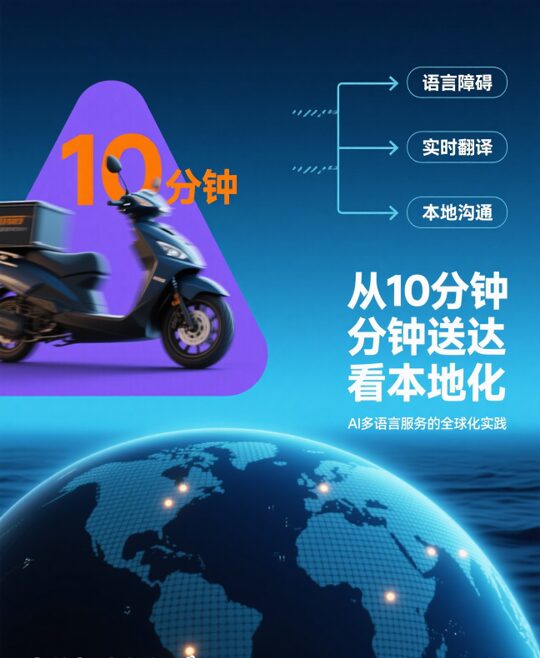
AICore Value Dimensions of Multilingual Services
Cost Optimization: Automation tools replace traditional manual translation and localization operations, reducing upfront overseas expansion costs by 30%–50%.
Efficiency Improvement: The product information localization cycle is compressed from an average of 21 days to within 72 hours, achieving exponential improvement in market response speed.
Precision Reach: AI algorithm-based SEO optimization and social sharing functions increase content exposure in target markets by 2–3 times.
Image Building: Standardized output of multilingual corporate profiles and promotional pages helps SMEs quickly establish a professional and trustworthy international brand image.
The democratization of technological tools is breaking down resource barriers in global operations, ensuring SMEs no longer miss out on emerging market opportunities due to scale limitations. As AI multilingual services become fundamental infrastructure for overseas expansion, the competitive focus for SMEs will shift from "whether they can go out" to "how to go deep." Behind this transformation lies the reconstruction of localization capabilities enabled by technological empowerment, as well as an inevitable trend toward a more balanced and diverse global business landscape.